
Buried Pipeline Protection and Coating Repair
Buried steel pipelines fail at the joints and the repairs, not in the mill-applied coating. Field joints, fittings and locally damaged 3PE or FBE coating are completed on site, in trench conditions, often in weather a liquid coating cannot tolerate. Soil stress then works on whatever was applied, and cathodic protection current is wasted wherever the barrier is discontinuous.

Buried Pipeline Protection and Repair
Buried steel pipelines fail at the joints and the repairs, not in the mill-applied coating. Field joints, fittings and locally damaged 3PE or FBE coating are completed on site, in trench conditions, often in weather a liquid coating cannot tolerate. Soil stress then works on whatever was applied, and cathodic protection current is wasted wherever the barrier is discontinuous.
Corrosion risk
- Coating disbondment at field joints and cutbacks, with water ingress behind the coating.
- Soil-stress creep, indentation and impact damage during backfilling.
- Shielding of cathodic protection current under a disbonded coating.
- Microbiologically influenced corrosion in wet, poorly drained ground.
Two configurations
New construction — bitumen-adhesive PE tape as the economical continuous wrap, with
PP mesh-reinforced tape where soil stress and backfill are severe.
Rehabilitation and complex geometry — viscoelastic tape applied without primer.
It cold-flows into the surface profile, bonds to steel, PE and FBE alike, and does not shield
cathodic protection.
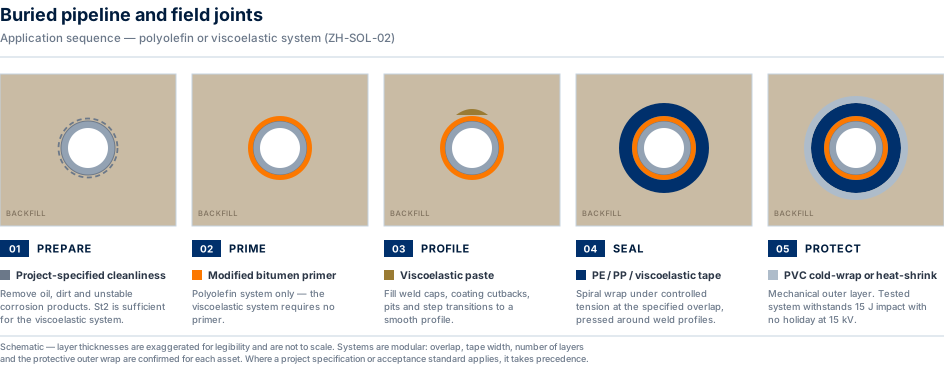
Which tape is right for a buried pipeline field joint?
The answer depends on whether the work is new construction, a local coating repair or a difficult detail around a fitting. The wrap should be selected with the backfill, cathodic protection and outer mechanical exposure in view.
New buried pipeline
Use the PE or PP system with its matching modified-bitumen primer when a continuous polyolefin wrap is required for new steel, field joints or fittings. PP mesh reinforcement is considered where soil stress and backfill are the governing risks.
Compare PE and PP tape →Failed 3PE or FBE coating
For rehabilitation and locally damaged coating, the viscoelastic system is selected where a primer-free application and compatibility with cathodic protection are required. Confirm the repair boundary and document the existing coating before wrapping.
See the viscoelastic system →Before backfilling
Check the field-joint diameter, overlap, operating and installation temperature, backfill material and any specified outer wrap. Share the project acceptance standard so the proposed configuration can be checked against the right test documents.
Send a pipeline enquiry →Send us the asset, we will propose the system
Asset type, dimensions, operating temperature, exposure and estimated quantity are enough for us to return a system configuration, a material estimate and the supporting documents.